
In this documentary, film maker Johan Grimonprez links the CIA’s use of Jazz in the Cold War against Russia with a deep dive into the divisive, murderous political machinations of Belgium and the USA which resulted in the 1961 assassination of Congolese Prime Minister Patrice Lumumba.
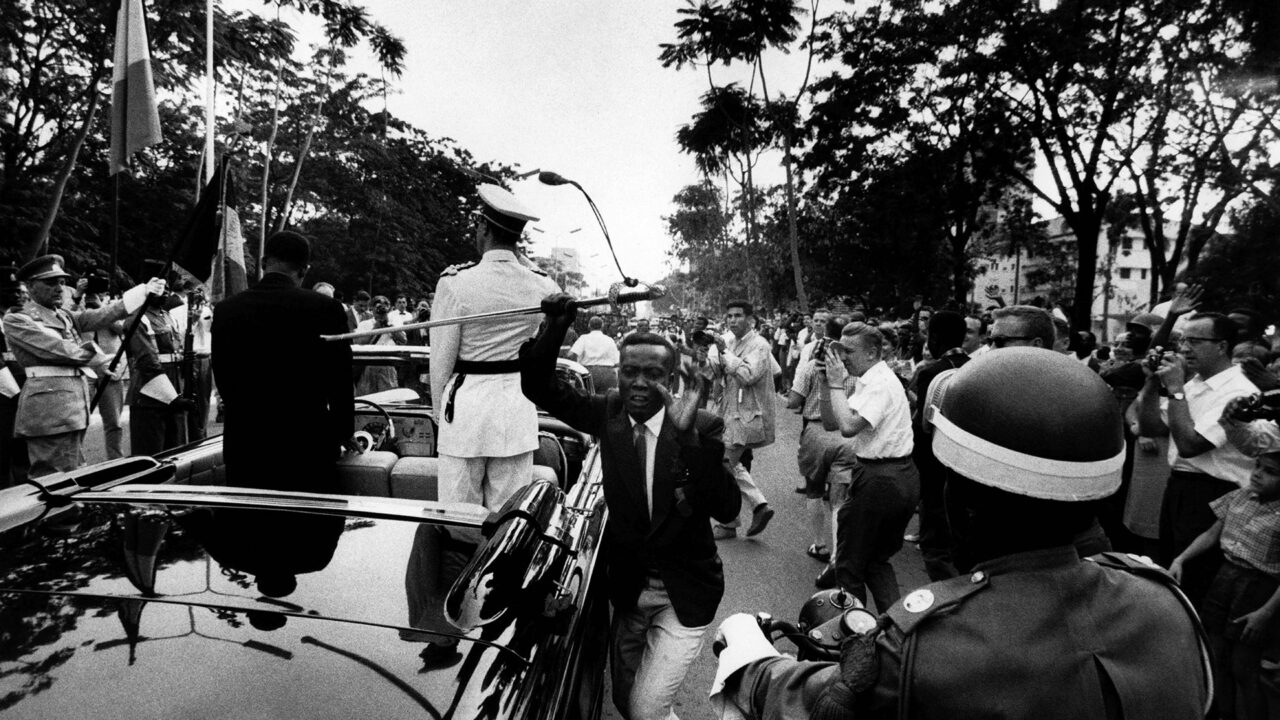
A Congolese citizen seizes the sword of Belgian King Baudoin at the independence parade.
On Tuesday night we braved the wind and rain and headed to the ICA to take in Johan Grimonprez’s documentary, Soundtrack For A Coup D’Etat. Being a jazz-head and a staunch supporter of the post war anti-colonial , anti-imperialist African liberation movements, I was super keen to see this documentary on a big screen.
Though I was aware of Patrice Lumumba’s assassination, after the Congo won its independence from Belgium in 1960, I was not prepared for the story this film delivered via interviews, archive film footage – from the UN and other news sources, along with written communications by politicians from Belgium, the USA and elsewhere.
Belgium has a deranged and deeply dark past in the Congo. In the late 1800’s, during the rule of King Leopold II, 15 million Congolese were murdered. This remains the highest known figure of genocide in world history.
However, this film is concerned with a more recent chapter in Belgium’s colonial history and is located in the post WW2 era, when momentum was gathering in the African nations for an end to colonisation and independence.
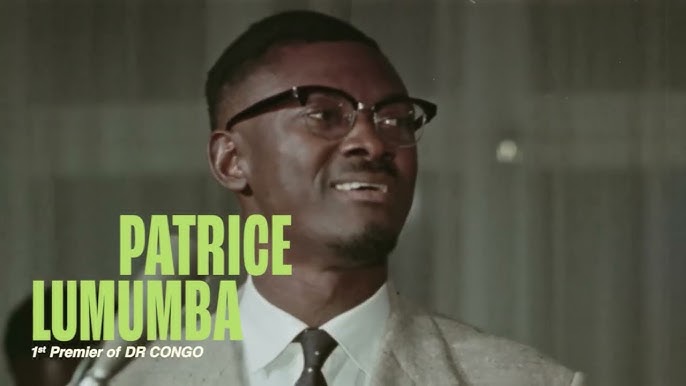
While Nkrumah was active in Ghana, so the independence movement in the Congo was also gaining traction. At the forefront of this movement emerged a young Pan Africanist, Patrice Lumumba. In1958 he became the leader of the Congolese National Movement and he was instrumental in leading the people to independence. He was elected the Congo’s first African Prime Minister.
Tragically, in the eyes of the USA and Belgium – and the British – he was branded a communist. In the shadow of the Cold War with Russia he was therefore a threat that needed to be dealt with, especially as the Congo was uranium rich. Even after independence, Belgium’s Union Minière controlled the strategically important Shinkolobwe mine – the uranium mined there was used in the Manhattan Project which produced the atomic bombs that destroyed Hiroshima and Nagasaki during World War 2.
The Congo could not go “Communist”. As such, every shadowy branch of the Western intelligence communities set to work with the intention of dividing and ruling the Congo. First the uranium rich state of Katanga declared independence from the Congo and then recruited Belgian backed, mostly South African mercenaries, to institute a reign of terror. It was then left to a Congolese army officer – Mobutu Sese Soko – to deliver the coup and oversee the capture and assassination of Lumumba.
It’s a complex tale with numerous pivotal players. At heart of it is the role played by the US controlled United Nations. It’s fascinating to see the Soviet Union’s Khrushchev in full anti-imperialst flight and thumping the table at the UN before heading off to Harlem to meet up with Fidel Castro and Malcolm X.
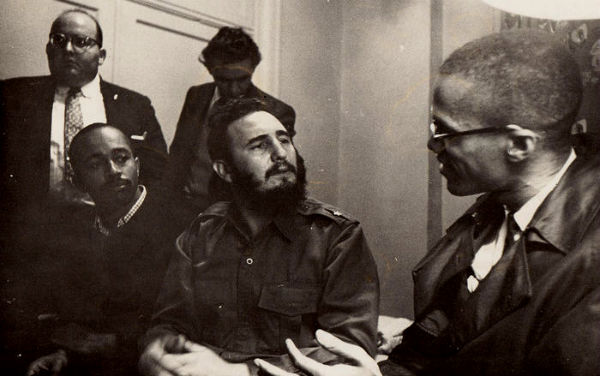
Fidel meets Malcolm X at Hotel Theresa , Harlem 1960
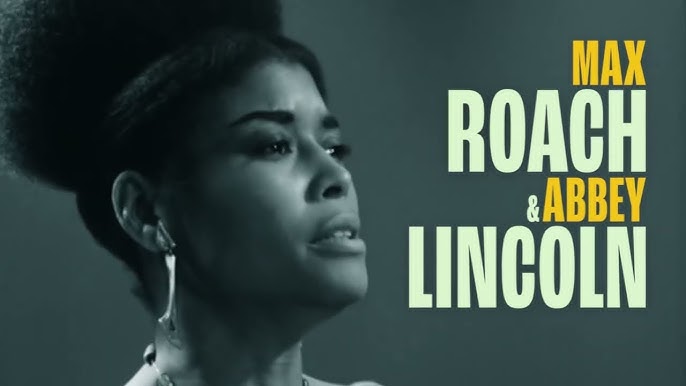
This complex tale is intercut with footage of jazz musicians who, on the one hand aligned themselves with the Pan African struggle, and, on the other, were recruited by the CIA to take America culture – Jazz – into the Soviet Union and beyond. This footage provided a fresh dynamic to the narrative. Along with Louis Armstrong, Dizzy Gillespie, Melba Liston, Duke Ellington – all of whom were recruited for various tours – we also get footage of Art Blakey, Mingus, Eric Dolphy, John Coltrane, Max Roach and Abbey Lincoln (who took part in an invasion of the UN) which, I guess, is included to reflect the intensity of the Pan African and Civil Rights struggle on the home front. A good friend, with whom I watched the film, was not impressed with some of that footage, which appeared annoyingly whimsical in the context of the deeply disturbing Congo footage. She also felt it had been somewhat shoe-horned into the narrative.
My own sense of deja vu was eased when I recalled having seen Hugo Berkeley’s excellent, 2018, PBS documentary ‘Jazz Ambassadors’ – a film we reviewed in Straight No Chaser. In 1955, Adam Clayton Powell, Jr. convinced President Eisenhower that jazz was the best way to intervene in the Cold War cultural conflict. It’s a documentary (now available on YouTube – https://youtu.be/u6wErAZkXEw?si=rjBMcIowELW6Zk06 – that provides a wealth of research combined with quality footage to give an insight into the Cold war clash between the Soviet’s Bolshoi Ballet and New Orleans’ Louis Armstrong.
There are many enduring moments in Soundtrack For A Coup D’Etat. The story of Madame Andree Blouin is one. A writer, political and human rights activist, she remained a dynamic force behind the actions of Lumumba. It’s a story that comes to an end in the film when Mobutu’s soldiers arrive at her house. She is deported but forced to leave children behind in order to secure her silence.
On reflection, I think if anyone asks me why, in the past, I was a communist, I would today say, ‘Go and see this film.”
(My Fave track dedicated to Patrice Lumumba: https://www.youtube.com/watch?v=tbmIFedIGao )


 ancienttofuture.com
Coming soon to theaters in France, don’t miss it!