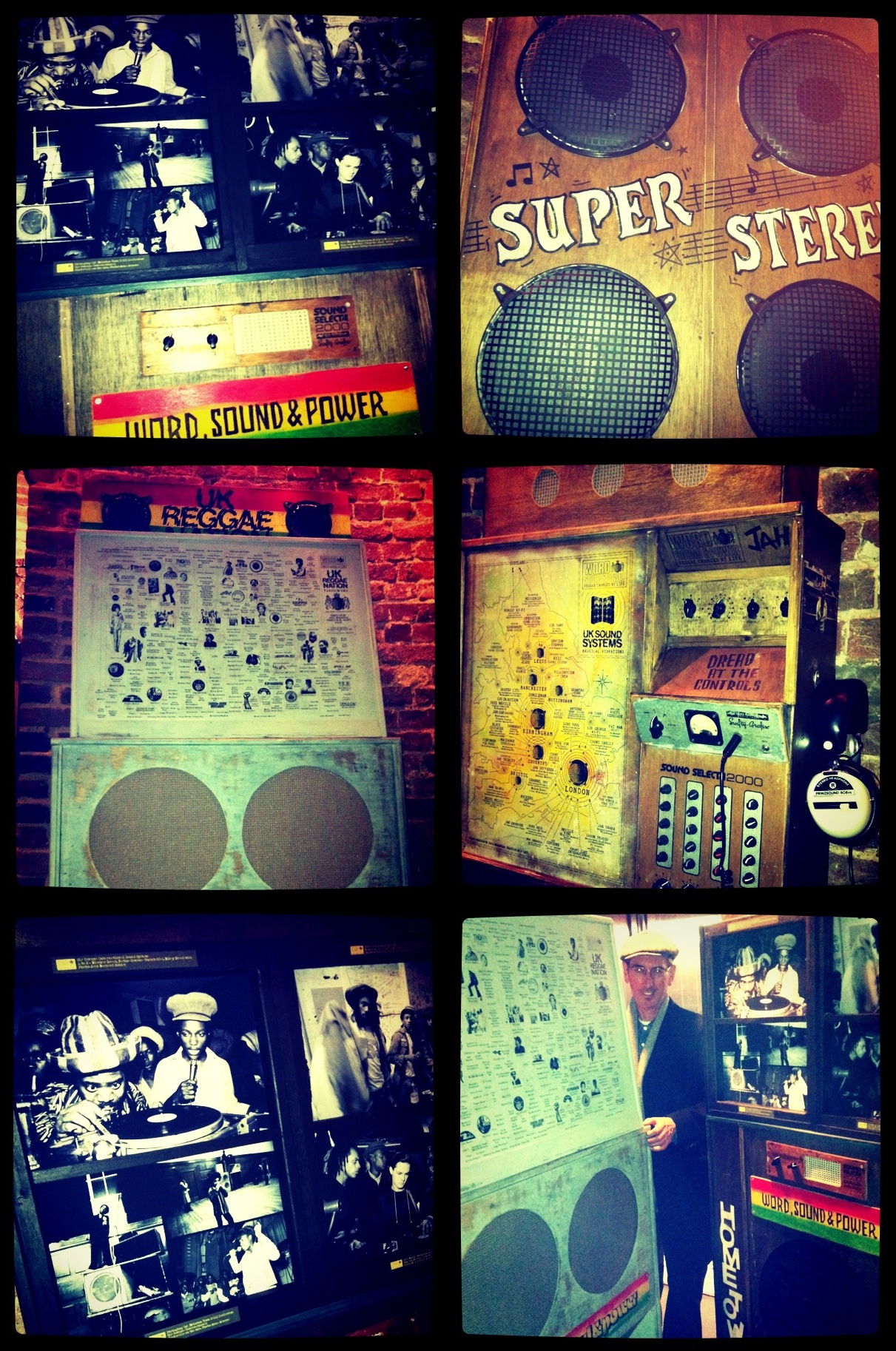
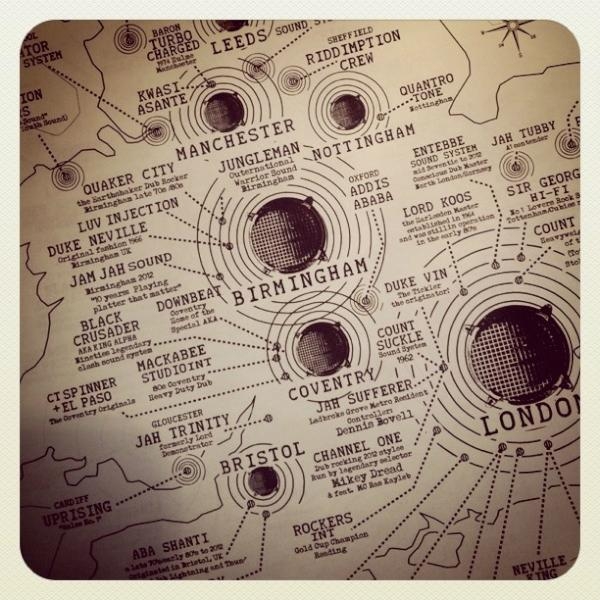
Following the debut of Word Sound & Power – Reggae Changed My Life (Stage 1) at the Bass Culture/Roundhouse forum, The people have spoken and we have released the premiere edition of our UK Sound System Map.
Drawing on an 18 page list of UK sound systems this a non definitive, cross generational, rootical selekshaan from Duke Vin onwards!
Soon come: Sound system maps for London… Midlands…. Respect to all Sound System operators…. this is just the beginning.
None Shall Escape The Judgement.
This digital print is 290mm x 390mm (h) and printed on Epson watercolour paper… Fits in an IKEA Ribba frame (40 x 50). Nice!
Swifty & I are working on Word Sound & Power – Reggae Changed My Life (Stage 2) and plan to debut this over the summer at the Bass Festival in Birmingham and at the British Music Experience at the 02 alongside an exhibition, currently showing at the Grammy Museum in LA – Bob Marley: The Messenger
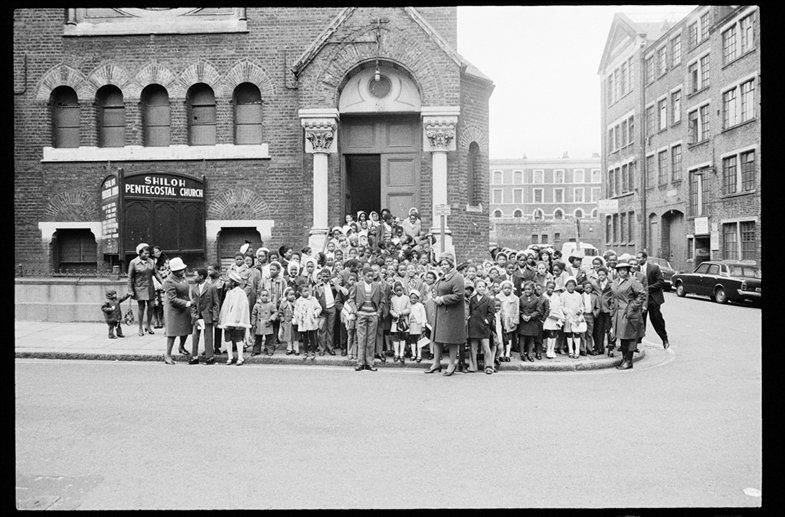
Staying on a Dalston vibe…. fresh from Autograph ABP comes Dennis Morris’ ‘Growing Up Black’. Born in Jamaica but growing up in Hackney Dennis was encouraged to pick up a camera by a patron of his local church, Donald Paterson. It became an obsession.
While his mates were football crazy he spent all of his time taking photos. Aged just 11, his photo of a PLO (Palestinian Liberation Organisation) rally was published on the front page of the Daily Mirror. He was paid £16. However, Dennis’ big break came when he met Bob Marley after a sound check at The Speakeasy in Margaret Street. Bob took a shine to the camera toting 14-year-old and invited him to be official photographer for the rest of that groundbreaking, but short lived, UK tour with the Wailers. The next morning Dennis packed his PE bag and off he went. It was the start of an auspicious career.
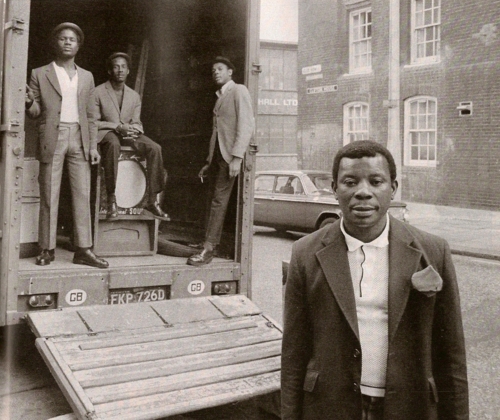
Admiral Ken & his Box Men
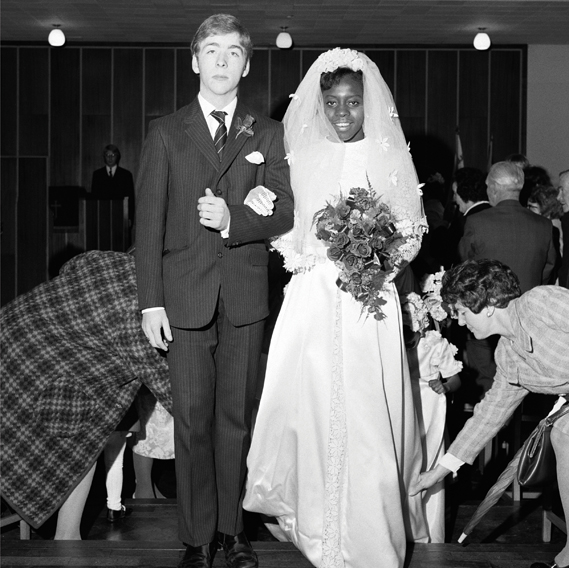
Despite not being able to scrutinise the whole of this book, due to the lack of readies required, I have gleaned that over the 95 B&W images it goes deep, very deep, into Dennis’ archive. What the viewer gets is the teenage Dennis Morris, hanging with his mates, shooting kids in the street, documenting mixed race weddings in Mare St Town Hall, focusing on Admiral Ken’s box boys and capturing some style and pattern at his home studio!
Dennis Morris-Home Studio: 1971-75
According to Stuart Hall, the founder of Birmingham’s seminal Institute for Cultural Studies, who wrote one of the pieces included in the book. “In this selection from his archive, Dennis Morris gives us a beautifully well-judged and eloquent portrait of the black diaspora, frozen at a particular moment in time. It is pregnant with anticipations of what is still to come, infused with future possibilities. We are invited to read these images backwards and forwards. Growing up black in the 1970s, they suggest, was not so much a state of being as a state of becoming.”
Wedding - Hackney Town Hall
Dennis Morris is a don and Growing Up Black, is indeed essential viewing. However, this book is lavishly produced and drops as a limited edition of 500 copies, each of which includes a signed silver gelatin print. The package sells for £300.00 – so, treat yourself or cajole your local library into ordering a copy.
Just as I was imbibing the news that Hackney Council and the Met’s Operation Condor has homed in on Dalston and Shoreditch, targeting anyone flouting the licensing laws, clamping down on the illegal venues, using sniffer dogs outside the train stations and busting taxi touts, beggars, thieves and geezers with a taste for violence and affray… up pops the ever dapper Rob G aka Earl Zinger with an apt and bluesy musical missive that pays homage to his gran… the Duchess Of Dalston … and takes us on a late night trawl of the Kingsland Road.
While writing the David Hockney piece I had saxophonist David Murray quietly firing on all cylinders in the background. I suppose it was a conversation I’d had with Gerry Lyseight about the New York Loft Scene and Val Wilmer’s book As Serious As Your Life that prompted me to dig into the vinyl and pull out Murray’s debut LP ‘Low Class Conspiracy’. I bought that album in Ray’s on my way to work in Covent Garden. That was back in 1976, David Murray was 21 years old and as a “card-carrying Commie” I most definitely identified with the spirit of the album’s title.
Some years later, around time of his ‘Creole’ LP, I interviewed David for Straight No Chaser but before I could write it up it the cassette got lost in an office move! I was devastated. It was a deep interview that covered a whole heap of ground. As we talked, the sound of James Newton’s flute drifted magically from an adjacent window.
It was around the time of the Ken Burns jazz documentaries and he talked of his deep vexation of being written out of the music’s history by Wynton Marsalis’ who’s derisory view of the “free” players had been given disproportionate attention and credibility. We talked about Guadeloupe and Martinique and the writings of Aime Cesaire as opposed to those of Patrick Chamoiseau. He described playing his horn at a naming ceremony, alongside the ka drummers, in the midst of the cane fields, until his gums bled.
On tenor or bass clarinet, David Murray is of the most compelling and spiritually charged saxophonists alive today and following on from playing ‘Low Class Conspiracy’ it was a natural progression to touch down on his contributions to Kip Hanrahan’s Conjure collective and his expansive collaborations with the Gwa-Ko master drummers of Guadeloupe.
With David Murray’s Guadeloupe cane field sessions in mind I just to had to share this firing slice of riddimic joy featuring François Ladrézeau. Flash it.
Saturday night… 9.30pm… Royal Academy in Picadilly… and it’s buzzing with people of all ages, nationalities and classes, all vibed at the prospect of viewing David Hockney’s A Bigger Picture.
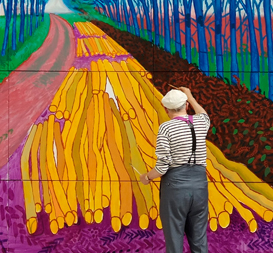
The Man at work
There’s been a rake of media publicity around Hockney’s work of late and it’s clearly reflected in the queues round the block at the Royal Academy and the tiny window for on-line tickets. Guaranteed to stoke the fires of controversy was an impish diss, aimed at Damien Hirst, whereby Hockney included the line, “All the works here were made by the artist himself, personally”, on the posters promoting his exhibition.
That said, he is undoubtedly an affable fellow and a serious grafter who is passionate about his craft. As a painter has definitely endeared himself to both the media and public who are at one with his exuberant celebration of the Yorkshire countryside. Hockney is more hip than ever and not surprisingly his “slouchy… disheveled cool” has earned him style icon status.
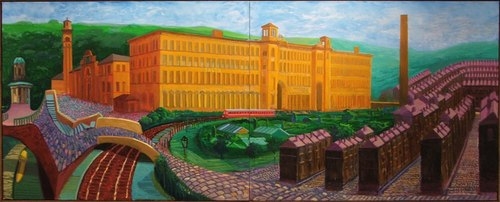
Hockney was born in Yorkshire but is a long-time resident of LA. Over the past couple of decades it’s his relationship with his photographer sister, Margaret, and his now deceased friend, Jonathan Silver, who initiated the 1853 Gallery in Saltaire, that has consistently drawn him back to his birthplace.
1853 Gallery Saltaire
As one enters the octagonal space that opens this massive show, the viewer is confronted with the cycle of nature and the four seasons. While this show is full of life death seems to hang over it like a shadow. Set against the rich sienna coloured walls these large paintings set the scenario and immediately draw you in, making you instantly aware that it’s a combination of energy and abstraction that makes them work. Hockney’s paintings make me smile and laugh. He challenges you to look hard and long, to penetrate the layers and go beyond the surface. If you said to Hockney that the Yorkshire dales or the English countryside have never looked like that, I’m sure he’d say, “But they do!”
This is a huge show and David Hockney, at 74, is nothing less than prolific. It made me jealous and today, makes me think, why am I sitting here writing this when I could be creating something of my own. Maybe, I’m just reflecting on lessons learned. This exhibition gives us intimate access to the process involved in creating these works and Hockney wear his influences on his sleeve…. for example, think Vincent Van Gogh.
There’s a couple of rooms with earlier works including the Grand Canyon paintings and the photographic collages but we’ll skip over that and get down to the meat & potatoes and start with an impressive couple of walls of small oil paintings and gouaches.
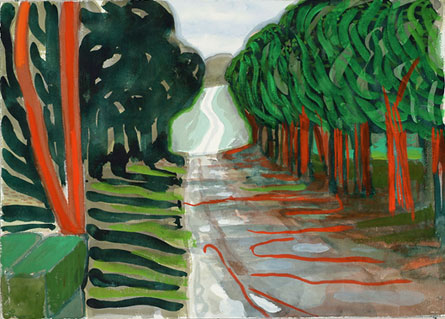
Arrival of Spring - Gouache
These “sketches” provide the foundation for a journey that progresses in a well defined order. Going from room to room is a thrill and at times the scale of it all is overwhelming. Some works were initiated in the field (literally) and finished in the studio. A painting like the Arrival Of Spring in Woldgate Wood borders on the “trippy” and definitely echoes his enthusiasm for creating theatre sets. Other works, like the cold, misty, November morning in Woldgate Wood, were dashed out over a couple of days! They are big paintings, done in panels. I’d loved to have been walking through that wood and come across Hockney, cap pulled down, overcoat on, fag hanging from his lip, hard at work…
'The Arrival of Spring in Woldgate, East Yorkshire in 2011 (twenty eleven)'.
November2006
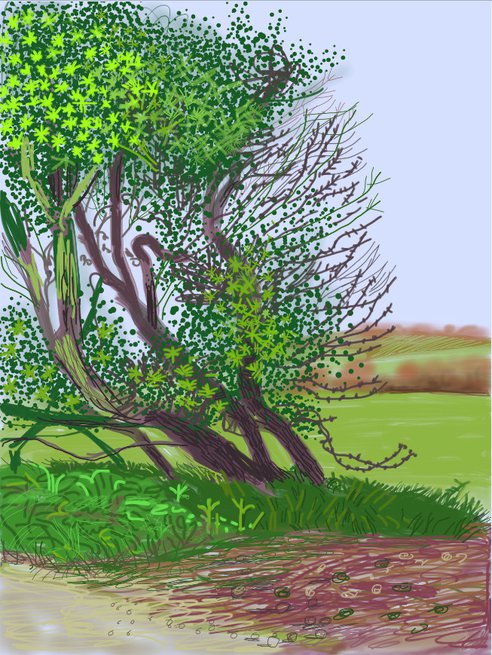
Along with deciphering the techniques of the old masters Hockney has extended his romance with new technology by producing a room full of “paintings” done on his ipad. I had to agree with a perceptive fellow viewer that they lacked the resonance of the oils and it would have been interesting to see some of them back lit, as on the ipad. Nit picking aside, the overall impact of his inkjet prints was impressive and the techniques employed thought provoking. How could you not be tempted to buy an ipad and treat it as a sketchbook after seeing this show? In fact, you should, after seeing his real sketchbooks, have both! Hockey is an artist/craftsman equally at ease with the rigorous demands of the fine art tradition and the rapidly evolving digital age and I love that.
Maybe I was on overload by the time I encountered the room of paintings where he interprets Claude Lorrain’s 1656 painting, Sermon On The Mount. Sadly, despite Hockney’s enthusiasm for this painting, which he has “restored”, his efforts simply washed over this viewer and as I stepped into the darkened room showing his split screen films I was ready to take the weight of my feet. Unfortunately, all the seats had been taken, curtailing one’s ability to relax and indulge in what has clearly become another dimension in the process.
I’d like to see this show again simply because the scale of it all doesn’t translate into a catalogue or a pack of postcards. But if I can’t, then I’ll have channel the inspiration and energy I felt upon leaving the Royal Academy and get busy with the sketch book and replace those dried up tubes of paint. Now, there’s a thought!
For the word from the man himself check the video below or tune to BBC iplayer and check the interview with Andrew Marr.
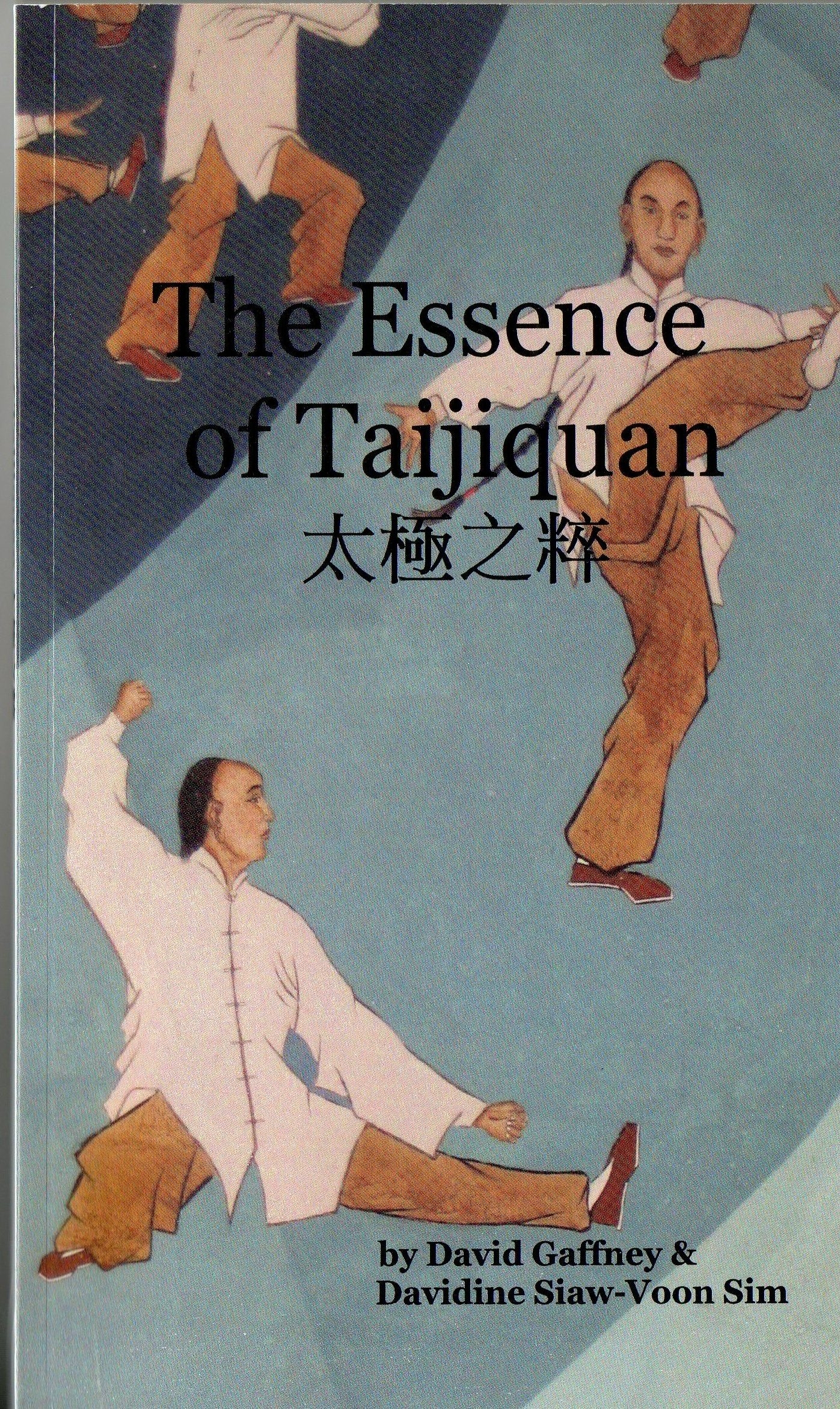
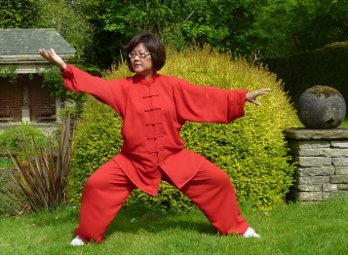
AFTER READING A TRIBUTE to one of David Gaffney’s life loving Chen taijiquan students, who is sadly no longer with us, I was finally prompted to pen a few words on his and Davidine Siaw-Voon Sim’s book ‘The Essence Of Taijiquan’.
Self published through Blurb, this is their second book on Chen family taijiquan, and I snapped up a copy within a few days of its release. That was few months ago, and since then I’ve been carrying around and dipping in whenever I’ve had a bus or train ride or whenever I’ve felt the urge.
My own involvement with taijiquan goes back almost three decades. I first came across Chen taijiquan when I was in Japan in the mid Eighties. Back then I was practicing Yang taijiquan (Chen Man-Ch’ing’s short form and Yang Chen Fu’s long form) and it was two Budo loving friends in Tokyo, who had been fortunate enough to train with the current gatekeeper of the Chen family, Master Chen Xiaowang, who gave me a video of him on Japanese TV demonstrating the 38 form. I was impressed. I was aware that Yang taijiquan had derived via Yang Lu Chan from the Chen family and this flowing form which was alternatively slow and explosive seemed to answer some of the questions and reservations I held at that time.
I studied and copied the moves from the first section of the form and showed it to one of my Tokyo friends. His response was, “Looks like it it but it’s not it.” A lesson was learned. Basically, you can’t learn solely from a video or DVD… you have to have a teacher.
Above: Chen Xiaowang mid 80s in Japan.
At that time, nobody in London was teaching Chen taijiquan so it went on the back burner. However, post the new millennium I encountered Kinthissa, a convert to Chen taijiquan from Yang style and a student of Master Chen Xiaowang. Through her I was introduced to the coiling, silk reeling core of the art and the importance of alignments and structure.
From Kintissa I progressed to Shifu Liu Jun Quan’s Taiji Circle in Camden. Shifu Liu has studied with Chen Zhenglei and Chen Xiaowang – two of the Four Tigers of Chenjiagou village – the home of taijiquan in Shanxi province – and he teaches the whole system which includes numerous hand and weapon forms that have both health and martial dimensions.
As this book, ‘The Essence Of Taijiquan’, is rooted in both author’s experiences of training as teachers in Chenjiagou village it is immediately relevant to my own chosen path. Their first hand knowledge and their rapport with the various high level teachers from different generations – Chen Xiaoxing to Chen Ziqiang – is consistently enlightening.
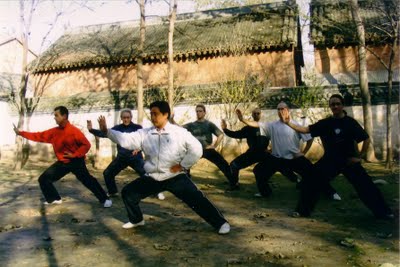
Chenjiagou training session
In journeying to the source we get an insight into life in the village itself. Despite the dark days and the repression of the cultural revolution, when many martial artists were hounded and persecuted, the people of Chenjiagou kept the art of taijiquan alive by practicing in secret. It seems ironic that today, Chenjiagou village, is thriving as the global epicentre for the study of Chen taijiquan.
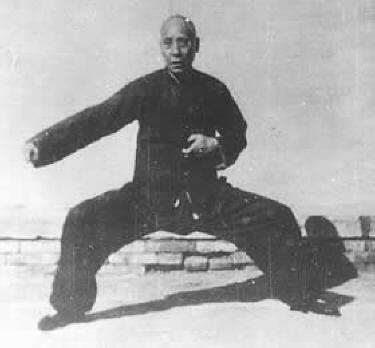
Legendary modern 20th century master: Chen Fake
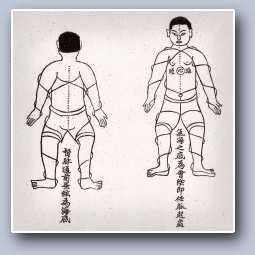
This book immerses us in the history of the Chen family and introduces the reader to Chen Wangting, who developed the foundation of this fighting art in the 17th century and the scholar Chen Xin who, in the 19th century wrote the classic Illustrated Canon of Chen Taijiquan. Gaffney and Siaw-Voon Sim touch on Daoism and the philosophical roots of the art and open up areas of discussion that relate to essential concepts of internal training from breathing in taijiquan to Chansijin (sik reeling) to the Six Harmonies..
Basically, the reader is given access to the training syllabus in Chenjiagou and that includes the various tried and tested paths you are required to take if you wish to progress through the five levels of skill they have defined through centuries of hard work.
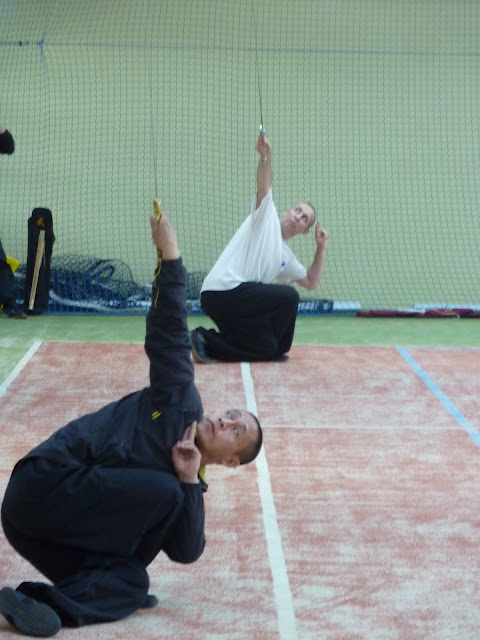
Chen Ziqiang + David Gaffney demonstrate jian - straight sword
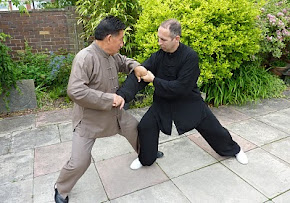
As such this book is relevant to anyone studying Chinese martial arts. It gives an clear overview of what is required of you, if you choose to train in this art. From foundation skills to bare-hand forms to sensing and push hands (tui shou) to weapons like straight sword (jian), broadsword (dao), spear (quiang) and Spring & Autumn B’sword (Chunqiu Dadao) we are taken on a rapid fire but most succinct tour. In fact, one the great things about this book is that it provides us with the essential concepts and the Chinese names and terms that go with them. Even though I don’t speak Chinese (apart from thank you (Xie xie) and one, two three, four (yī èr sān sì … ) it’s most useful to wrap your head around terms like, peng, kong, an, ji, zhan, lian, jin etc.
Having experience serious frustration and disillusionment with my own practice at different times I feel this book provides a handy reminder that we all need good teachers who can guide us through the various stages and in many respects ‘The Essence Of Taijiquan’ also shows us what we should be expecting from those who do teach – especially in relation to qi development and martial applications.
Above: Around 4.18 Master Chen starts tossing new generation master Chen Bing around!
All in all, there is a lot of information in this book to take on-board and I’m sure I’ll be dipping it on a regular basis. It’s also whetted my appetite for the forthcoming translation of Chen Xiaowang’s forthcoming book on the Five levels Of Skill.
The Essence Of Taijiquan is an aid to practice, it gives a framework to operate within, and in conclusion I’ll quality all this reading by quoting Chen Fake’s nephew, the legendary Chen Zhaopi on the need for daily practice, “Winter or summer, wind or snow, there should be no interruption. In time the heart will accept and the spirit will understand, and the wonderment of the fist will be realised.”
Loved that scene in HBO’s Treme when Big Chief Lambreaux appears out of the dark having returned, post Katrina, to the his devastated, old neighbourhood… and proving that spirit is allive and kicking is a pic (below), by my good friend Pam Esterson, that she posted from Mardi Gras a few hours ago… Meet the boys on the battle front….
Below: Check this is short clip of Chief Lambreaux and his gang practicing ‘Shallow Water, Oh Mama’
+ Dig this book…. some brilliant photographic portaits:
Eyes of Eagles New Orleans’ Black Mardi Gras Indians by Christopher Porché West (Blurb)
Wednesday night the Roundhouse Rising … British Underground’s Bass Culture Forum …. this sold out session featuring a panel of players rooted in the contemporary reggae scene was the perfect place for Swifty and myself to premiere the first stage of our “installation” illuminating the evolution of the UK Reggae Nation. It has to be said, the response to the “boxes” was universally good with everyone ready to add to the mix of info.
PB & Spatial AKA Orchestra's Jerry Dammers
The discussion was loosely chaired by Mykaell Riley, an original member of Steel Pulse and the Director of Black Music Research UK and it gave us a taste of what they plan to present to at SXSW in Texas in March. Bass Culture, as an all embracing term that covers all UK music that derives Jamaica, was the topic.
A cross generational and enthusiastic gathering it was most pleasant to see Jerry Dammers sat alongside Ras Kwame and visual artists like Ian Wright and David Corio.
There was a portion of to-ing and fro-ing between the audience and panel that included the excellent Mikey Dread (Channel One Sound System), Lea Anna (singer/dancehall), Robbo Ranx (BBC Radio 1Xtra) and Curtis Lynch (Necessary Mayhem) but little consensus.
For myself, Bass Culture could work as an umbrella in an academic sense and help leverage more courses that deal with the Black roots of the music in Universities. As for the music industry… Bass Culture – The brand… I can’t see it!
While we were putting together the “boxes” for this event we began to get a real picture of how an infrastructure – shops, van-men, importers/distributors, live promoters, record producers, musicians & singers, clubs, sound systems – evolved during the 60s/70s/80s to promote the music to the Jamaican/Caribbean community and beyond.
For most Afro Caribbean youth in the 70s and 80s… Yard was where it was at but time has run and passed and subsequent generations are definitely more attuned to their own immediate inner city runnings. They respect their roots but over the past three decades they’ve created their own dynamic forms of reggae rooted music – lovers, jungle, drum ‘n’ bass, grime, dubstep….
Combine that creativity with the internet/digital revolution and we have to ask: Is there an infrastructure s that will allow these underground movements continued development; that gives props to the artists and ensures they get paid; that allows them to nail their colours to the mast and declare, ‘These are our roots and they deserve recognition.””
In the final analysis, it all seems to come back to politics and money. If you have an infrastructure then you can make money and that creates the basis for power so I’m not sure that defining the continuum as Bass Culture will help Necessary Mayhem sell more music or guarantee Lea Anna a future as the UK No.1 dancehall queen.
Swifty: Stringing up!
I’m sure that the debate will continue to bubble but, right now, it’s back to our installation: we loved the fact the speaker boxes had a genuine physical resonance with people and they were consistently referred to during the discussion as reflection of the foundation of the music and where we’ve all come from.
Unfortunately, the lighting was subdued so people might have missed out on the information that graced the sides of the boxes… sound system flyers, shop and club ads, a list of top 20 UK chart reggae hits, Penny Reel‘s 1981 list of UK sound systems, a few influential UK 7″ singles, rare fanzine covers etc.
Still, it’s a beginning… and as it grows the combination of words sound & power will shake the walls of Babylon 2012.
Saturday night at the Roundhouse in Camden Town . It’s busy. In the main room, post-emo college rock band, Brand New, was pulling a heavy crowd. Meanwhile, in the small theatre, a more modest gathering was gradually assembling to get a taste of British Underground’s reggae inspired foray in SXSW in Texas in March.
Building on a slow start Ras Kwame flung down a selection of tunes that illustrated the evolution of reggae in the UK from ‘My Boy Lollipop’ onwards and if he appeared dropping it inna Rodigan style that’s simply how it turned out.
Rasites
According to my good friend Penny Reel, Rasites hail from Hackney, and they touched down on the stage first. These second generation Rastafari musicians delivered a fast flowing set that embraced classical, live, roots reggae along with lyrical flavours synonymous with Jamaican Bobo dreads like Anthony B and Sizzla.
They laid the foundation, rocked a predominantly young white crowd and fired up one crew of determined, teenage, skanky steppers. Once the Rasites set was done they settled into the role of backing band and were joined onstage by singer songwriter Natty. Judging by the audience response, this acoustic guitar toting troubadour has already got a devoted following and looks set to build on it. Lyrically, he’s rooted in the now and he’s developed a vocal delivery with an urban edge that retains a reflective conversational style. On this night, his songs were effortlessly complimented and boosted by the muscular presence of the Rasites.
Following a short break where Ras Kwame berated certain sections of the crowd who insisted on talking through everything he invited onstage the final performer of the evening, the inimitable Lady Leshurr.
I’d expected to hear this feisty Brummie wordsmith within a digital/dj setting but no, she took to the mic with the versatile Rasites behind her. Brimming over with confidence, this girl may be tiny but she’s destined to be large. Proud of her Midlands roots she popped off volleys of rapid fire lyrics dedicated to her home town and set the place alight with her rendition of Sister Nancy‘s ‘Bam Bam’. She sings and spits lyrics at a speed that is mind blowing. Some of it may well be totally impenetrable but a track like ‘Lego’ more than illustrates her lyrical ingenuity.
In SXSW the crew will be joined by Harleden don, Gappy Ranks and cult rootsman Little Roy delivering his version of the classic Nirvana LP ‘Battle For Seattle’. All in all it’s a most interesting combination but how the UK Bass Culture concept will be received in Austin remains to be seen.
PB
On Wednesday 15th Feb (7-9pm) @ Roundhouse Rising presents Bass Culture – The Influence Of Reggae On British Music.
On nthe panel : Robbo Ranx (BBC 1 Xtra), Mikey Drea (Channel One Sound System), Curtis Lynch Jnr (Necessary Mayhem), Mykaell Riley (Iniv. of Westminster / Reggae Philharmonic Orch). Gate Fee: 2 quid
Swifty & I will unveil stage 1 of our our Word, Sound & Power installation that celebrates the UK Reggae Nation and paves the way for an increasingly extensive and collaborative show.
São Braz is a tiny community of fisherman, fieldworkers and Rastafarians, a place born as a quilombo, a refuge of runaway slaves in the past. It is located outside the town of Santo Amaro, in the Bahian Recôncavo, and buried here in the midst of the cane fields are the roots of Samba – part of the cultural legacy of the Bantus brought from Africa to work the plantations.
Samba Chula is one of the variations of Samba de Roda. The complicated cadences of rhythms and call-and-response singing, as well as its melodic loops played out on the rare double-strung guitar (viola machete), are some characteristics of the Samba Chula played in São Braz and this form of Samba has been proclaimed by Unesco in 2005 as a Masterpiece of the Oral and Intangible Heritage of Humanity.
That said, Samba Chula is a tradition in danger of extinction and it’s being kept alive by two brothers, João do Boi and Alumínio, both Masters of the oral tradition of Samba Chula, and their friends and family. They perform as Samba Chula de São Braz and tonight they bring their deep and uplifting music and dance to Momo’s in central London
Loving this video of them live at WOMEX.
+ Track down their excellent CD “Quando Eu Dou Minha Risada, Ha, Ha”.
POSTSCRIPT:Yessss… a night was had! The intimate and steamy atmosphere of MOMO’s was spot on. The ridims of the pandeiros meshed with the congas, the pulse of the surdo and the tres-like voila machete. The voices rose and fell in time to the hand claps and the shufling steps of the samba were demonstrated by each member of Samba Chula de São Braz before inviting one and all “onstage” to pop a little style. Gotta thank Jody Gillett for pulling the session together… and have to say it gave me the same deep, warm feeling I had the first time I heard Paul Nabor and the Paranda masters from the Garifuna community on the coastline of Belize.
Plum Publications
Excellent resource for run by Ted & Debbie in California, both long time martial arts practitioners…. lots of books, dvds etc with informed reviews based on experience.
SUPA DUPA rare 'n' old skool Nigerian Ju Ju, Fuji & hi life…
Just haul up the the groovemonzter, log on & stream the majestic sounds of Sir Shina Adewale, Dr Orlando Owoh, King Sunny Ade, Cardinal Rex Lawson, Queen Oludunni Decency, Tunde Nightingale, Alhaji Sikuru Ayinde Barrister…. wonderful!
the blue moment
Richard William’s exellent reflections on the world of music and….
Plum Publications
Excellent resource for run by Ted & Debbie in California, both long time martial arts practitioners…. lots of books, dvds etc with informed reviews based on experience.


 x 390mm (h) and printed on Epson watercolour paper… Fits in an IKEA Ribba frame (40 x 50). Nice!