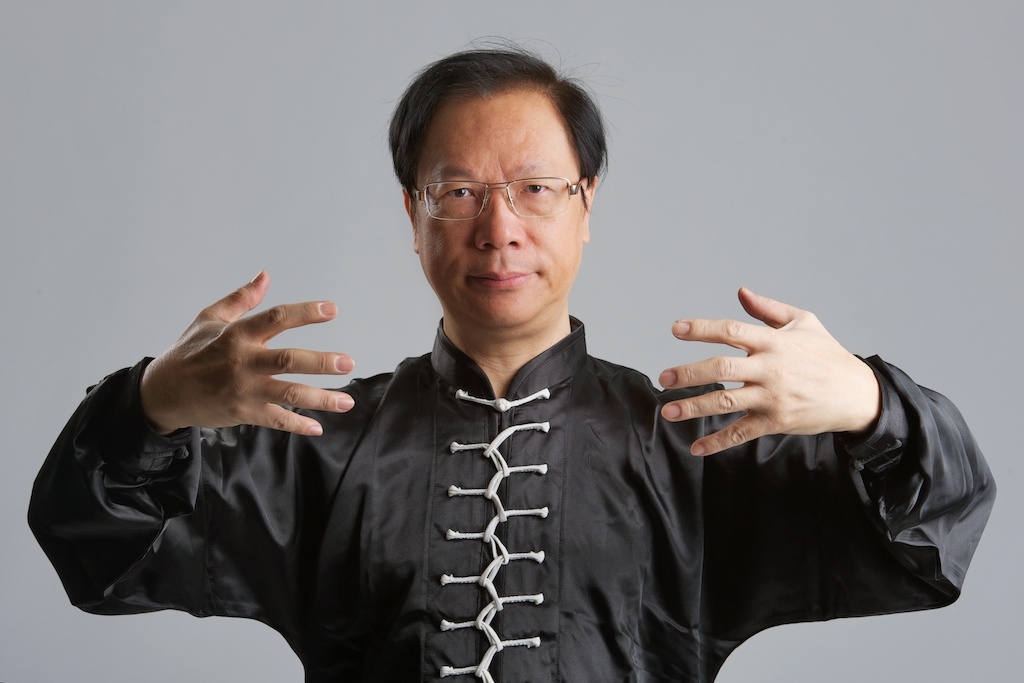
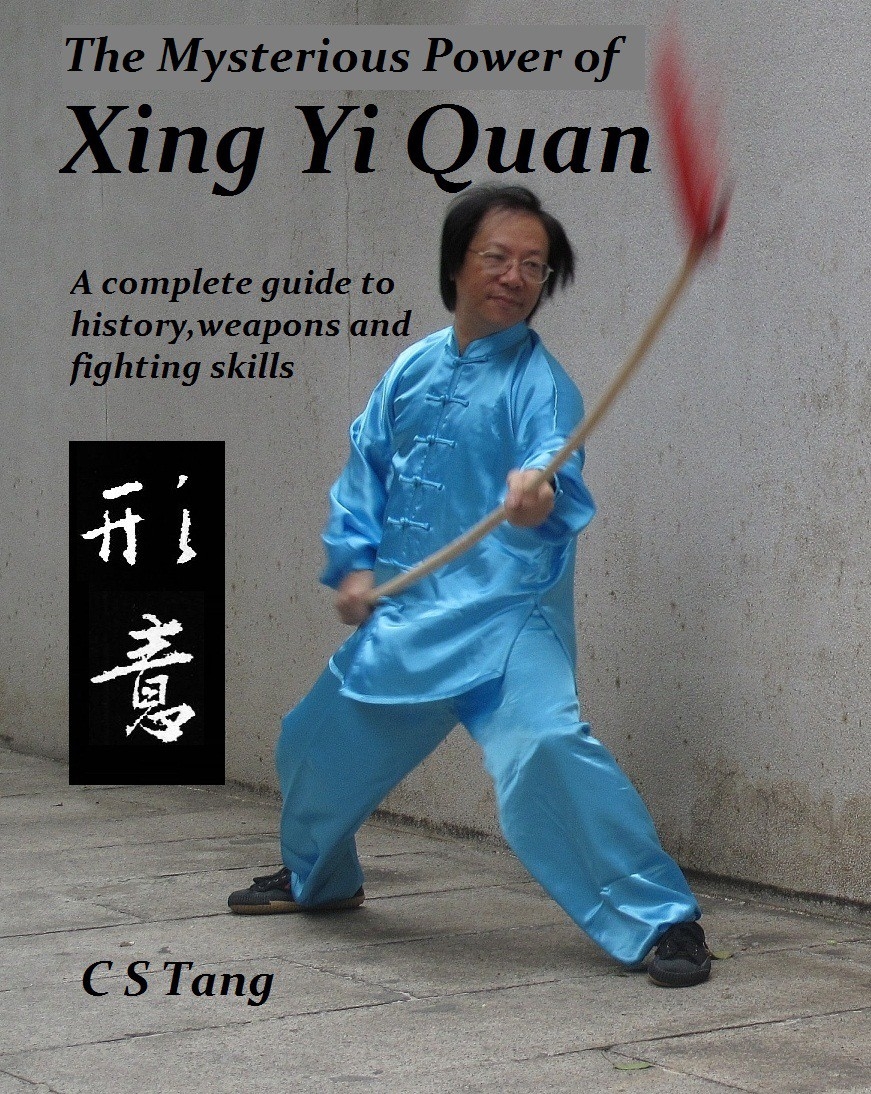
Exploring The Mysterious Power of Xingyiquan by Sifu C S Tang.

I first came across Sifu CS Tang when I was searching the web for xingyiquan and baguazhang material related to the famous Taiwan based martial artist Wang Shujin. From his Yang Xin studio in Hennessy Road, in the Wanchai district of Hong Kong , this stalwart of the local martial arts community  offers classes in Gao & Cheng style baguazhang, Yi Quan, Yang, Wu & Chen taijiquan, xingyiquan and pak mei. His rather chaotic looking web site and on-line store is a treasure trove of material related to the “internal” arts.  It includes some excellent material based on his  own, 40 years of experience, training in martial arts with renowned teachers from Hong Kong, Taiwan and the mainland.
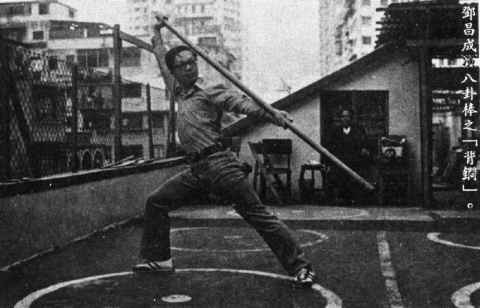
CS Tang: Back in the day!

CS Tang has produced instruction DVD’s 0n Gao bagua zhang and the Chen taijiquan of Grandmaster Feng Zhiqiang. He has sought out and studied with a host of famous practitioners including Liu Jing Ru – with whom he produced the excellent little book on Cheng shi Bagua Zhang – Dragon Stretches Its Claws.  However, following on from his  book The Way Of  Yi Quan, he has produced  large format, 300 page volume  entitled The Mysterious Power Of  Xing Yi Quan, and this book is now available in English from author and  nèijiā practitioner, Alex Kozma’s excellent Line of Intent publications
Along with taijiquan and baguazhang,  xingyiquan – “Form/Intention Boxing”, or “Shape/Will Boxing” – is one of the major “internal” / Nèijiā  Chinese martial arts and I became interested in it following a serious bout of illness that left me disillusioned with the Yang family taijiquan that I’d practiced. I wanted to stay in the Nèijiā  world but wanted something more aerobic, more dynamic. Xingiquan fitted that definition but it was hard to find someone who taught the system in depth. Having discovered that Marnix Wells , a student of Wang Shujin, has studied Wang’s xingyiquan, alongside his baguazhang, I looked him up and my own journey began.

Since then I have encountered various teachers of xingyiquan, including Alex Kozma, but sadly have been unable to maintain a consistent approach to learning the art. However, while I maintain my training in Chen shi taijiquan I keep returning to the Five Elements that form the basis of xingyiquan. I enjoy the challenge of the aggressive, seemingly linear movements;  the timing and coordination needed to generate bursts of power; the  simultaneous attacking and defending. One day I might even get even master a couple of the 10/12 sequences based upon the movements and fighting behavior of various animals.

So, on returning to The Mysterious Power of Xing Yi Quan let’s first of all establish that you cannot learn this art from a book. You need a teacher. That said, this book does deliver the flavour of xingyiquan.  Sifu Tang traces it’s complex history and he takes us down his own own path of learning, from his initial teachers in Hong Kong, where the practiced on rooftops and weapons were restricted to the pole due to lack of lighting (!)  to the mainland and the home of Song Family xingyiquan in Taigu City, Shanxi province.

ABOVE: Song Style Xingyi Quan at the Zhao family house in Dong-Gua shanxi, 1996.

That said, The Mysterious Power Of  Xing Yi Quanis not a historical travelogue. It is a very detailed reference book and training manual dealing with Hebei xingyiquan. Along with spelling out the specific alignments and the nature of the movements, each section is backed up  with clear, sequenced photos of the various forms – from the single elements (metal, fire, water, earth, wood) to the linking forms, two person sets & weapons – that make up xingyiquan.

Sadly, not all of us can afford to board that plane to go and train in Hong Kong or Shanxi and would therefore suggest that the author puts together a selection of DVDs that complement the content of the book and offer more specific, detailed information and training tips. However, as there is a comparatively small library of written works , in English, on xingyiquan, anyone who is training in the art will undoubtedly find this book informative and useful.

Above: CS Tang demonsrates Gao style bagua – a taster from his DVD set (not sure about the music!)

If you are interested you buy this book directly from Alex at Line of Intent Books (http://skydragoninstitute.webs.com/books.htm) for £22.50 + postage. It can be ordered by sending a Paypal order to kozma108@gmail.com
OR order from http://www.watkinsbooks.com/catalog/product/view/_ignore_category/1/id/10154/s/the-mysterious-power-of-xingyiquan/
Posted in Wushu | Tagged , , , , , , , , , , , , , , , | 1 Comment

Pinnacle & The First Rasta … the story of Leonard ‘Gong’ Howell

Following on from her celebrated book –  The First Rasta –  my long time friend, French music journalist and occasional contributor to Straight No Chaser, Hélène Lee,  has collaborated with Christophe Farnarier, and directed a compelling portrait of Leonard “Gong” Howell’s life.

The initiator and catalyst of the Rastafari Movement, Howell (1893-1981) is considered by many as its founder. The film follows the trail of a forgotten and overlooked, yet central character in the history of this movement.

In 1915, Leonard Percival Howell, boarded a banana boat and set sail from Jamaica. On his travels he encountered an array of thinkers: adepts of the New Thought and Bolshevism, anarchists and Gandhi followers, free-thinkers and Garveyites; each of whom is looking for some kind of Promised Land.

After 18 years of travel Howell arrives back to Jamaica with a head full of new ideas and in 1939 he creates Pinnacle, the first Rasta Commune  – a laboratory of a new way of life.

With a mix of archival footage, interviews with members of his first community and a dramatic sound track by Bunny Lee, Max Romeo, Val Bennett, The Abyssinians and Count Ossie’s Mystic Revelation of Rastafari drummers, Groundation, 100 Grammes de Têtes and Tu Shung Peng, The First Rasta makes fascinating and moving viewing giving an insight into the community of Pinnacle, which laid the foundation of a culture that has since spread to the four corners of the world.

Big respect to  Hélène Lee. She  is one of the most important global commentators on reggae music and Rastafari and any venture she takes on board I’m going to check out.   So far, the film had never been shown in the UK and is released on DVD in April. Don’t sleep on this.

Posted in Follytricks!, Words, Sound & Power | Tagged , , , , , , , , , , , | 2 Comments

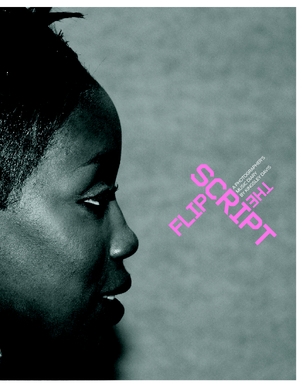
FLIP THE SCRIPT… now online.

Norman Jay MBE

Kingsley Davis’ has just launched his  new website with news, videos, shopping
and a selection of B&W prints now available.

The man himself is totally chuffed with the result and to mark the launch Kings has got another signed copy Flip The Script – the book – up for grabs.

He managed to catch up with Ms Dynamite at the recent Urban Classic with the BBC Symphony orchestra and she kindly signed a copy …. so, if you fancy a punt  simply visit the contact page and send Kingsley a message with Ms D in the inquiry box plus your contact info – simple!

http://www.flipthescriptbook.com/contact2.html

Posted in Just Runnings | Tagged , , , , , , | 1 Comment

ONE YEAR ON…. AFTERSHOCKS OF THE TOHOKU EARTHQUAKE

It’s one year on from the Tohoku tsunami and earthquake disaster and in the wake of the stirring images and stories that have reached us I am  more than hacked off with a bunch of pro nuclear power scribblers who are claiming that the disaster has been hi-jacked by the anti-nukes movement.

Their rationale is that 20,000 people died as a result of the tsunami but nobody has died as a result of the destruction at the Fukushima Daiichi power plant. On the surface that’s true but I’m also convinced that those workers who tried to get the plant under control in the early days of the disaster will pay the price. It’s more than bizarre that these pundits regard what’s gone on at the plant as a source of scare-mongering rather than an event with deadly long-term consequences.

Rather that get into a debate with those people, I would love someone to do a reality TV show where these journalist/commentators are transported , with their families, to live right on the border of the exclusion zone for 12 months. When  there, they will eat local produce (including the seafood) and their children will attend the  local schools which now have had the top soil removed from the playground.

Failing that I  need to refer one “journo” who smugly shrugged off the huge amount of radiated water that’s gone into the sea to the blog of a local school teacher – http://fukushima-diary.com/2012/01/live-minamisoma-blogger-ustream/ – who is clearly suffering from the effects of living in a disaster zone that has been rated alongside Chernobyl.

Like the TV footage of the Twin Towers, the footage of the Tsunami sweeping towns and its inhabitants off the face of the earth will stay with me forever. The pain caused by the magnitude 8.9 earthquake and ensuing tsunami will live on for generations in Japan. It remains shocking that today, in one of the world’s most affluent and developed nations, more than a quarter of a million survivors face up to five more years in temporary shelters.

The Asanuma family were driven by the tsunami from their family home in Ishinomaki, Miyagi, and have taken refuge in a temporary residence.

The Asanuma family were driven by the tsunami from their family home in Ishinomaki, Miyagi, and have taken refuge in a temporary residence. Photography by Shizuo Kambayashi

We’ve all seen the photos where once the debris has been removed the only sign that a town once stood there are the patterns, etched into the ground,  outlining the buildings’ foundations.  The Japanese government is currently spending about $258 billion on rebuilding but despite this massive sum, a full recovery may not even be possible. If it is achieved, according to authorities, it will take at least a decade.

Alongside the physical damage and death toll we have the ongoing catastrophe of the Fukushima Daiichi power plant – which is still a source of half truths and mis-information. Basically, there is a war going on between those who are  pro and anti nuclear power and in that context I prefer to shelve TEPCO’s statements on the plant and listen to someone like Arnie Gunderson – a former nuclear power executive who served as an expert witness at the enquiry into the Three Mile Island Incident – via http://fairewinds.com/

Japan still suffers the consequences of America’s willingness to experiment with the impact of nuclear weapons of mass destruction and people are quite rightly fearful of the radiation from the Fukishima plant. That fear  has undoubtedly been compounded  by hundreds of violent after-shocks that have taken place over the past 12 months. However,  the Japanese people have shrugged off a reputation for political indifference and made their voices heard. The result of intense public opposition to nuclear power is that only two of the 54 nuclear reactors in Japan are currently in operation.

For us in Europe, the Tohoku earthquake disaster led several countries, including Germany, to stop construction on new nuclear plants. However, that didn’t stop the French  sending their Industry and Energy Minister Eric Besson to Japan on the anniversary of the earthquake.

French Industry and Energy Minister Eric Besson visits the stricken Fukushima Daiichi nuclear power plant

The French are Europe’s  evangelists for nuclear power at home and around the world and in this cynical exercise Besson (see pic!) became the first foreign politician to enter the crippled Fukushima Daichi plant since the disaster. He informed one journalist  that nuclear power was too important a source of energy to abandon and told the workers in the plant they must revive atomic energy in Japan.

Basically, for the French, nuclear power is big business.  And that brings it all back home to the UK because according to the Guardian yesterday it looks like the UK is handing control of its energy future to France   http://www.guardian.co.uk/environment/2012/mar/13/uk-energy-future-france – and that’s not good…

The current situation in Japan demands we ask questions and demand answers. Nuclear power… is  it worth the risk? What are we going to do with all those spent fuel rods that can’t be recycled and will be lethal for 20,000 years + ?

Buddhist monk bows and offers a prayer in a neighborhood destroyed by the March 11 earthquake and tsunami in Onagawa, Miyagi Prefecture, on March 9, 2012, two days before the one-year anniversary of the disaster. Photography by Shizuo Kambayashi

PB.  15/3/2012

Posted in Deep stuff, Follytricks! | Tagged , , , , , , , | 1 Comment

Black Queens, White Lies, Red Herrings…. take a trip to the coast!

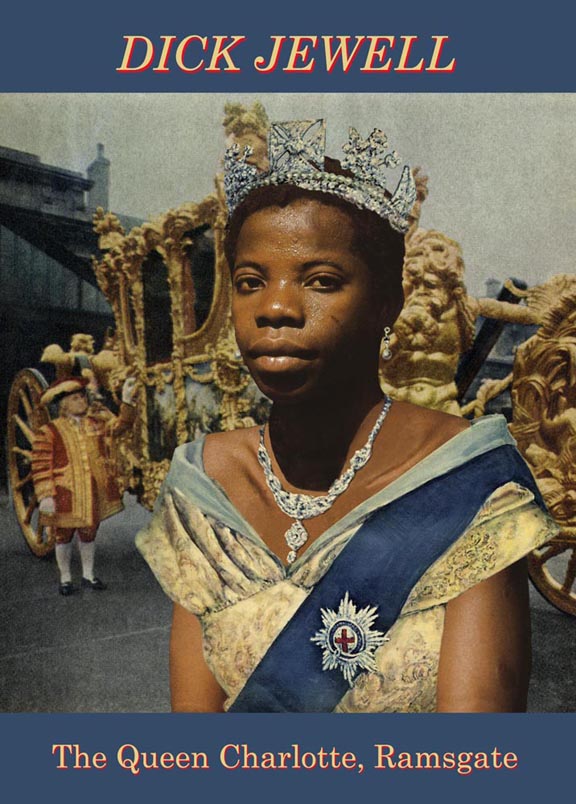
Go on & treat yourself… after all, Spring is in the air and it is the  Queen’s Jubilee! Head on down to the south coast in search another Queen –   The Queen Charlotte, the “liveliest new arts and entertainment venue” in Ramsgate where you will find Black Queens, White Lies, Red Herrings, an exhibition by Dick Jewell – an artistic ragamuffin if ever there was one.

Sadly, I missed the opening for  Black Queens, White Lies, Red Herrings but one can be sure that will be some excellent and most controversial pieces on display from this wayward film maker, photographer and  montage artist…. the last time I saw him he was talking someone through the reggae  soundtrack to his Super 8 film of skinheads in Brick Lane in the Seventies. Have I said enough?

To view Dick’s works and then partake of fine wines and choice beers you need to locate The Queen Charlotte at 57 Addington Street. It’s open  Thurs & Friday (5.30 – 11pm) +  Saturday (5.30 – 12pm) and the show continues until April 7th.

You can check out Dick’s site – http://www.dickjewell.com/– for a little taste …. and as a staunch republican I’m definitely lovin’ that flyer!

Art Contact at the Queen Charlotte: mark.hampson@royalacademy.org.uk

Posted in Deep stuff | Tagged , , , , , , , , | 6 Comments

OUT NOW! DUE TO POPULAR DEMAND! WORD, SOUND & POWER: UK Sound System Map

Following the debut of Word Sound & Power – Reggae Changed My  Life  (Stage 1)  at the Bass Culture/Roundhouse forum, The people have spoken and we have released the premiere edition of  our  UK Sound System Map.

Drawing on an 18 page list of UK sound systems this a non definitive, cross generational, rootical selekshaan from Duke Vin onwards!

Soon come:   Sound system maps for  London… Midlands…. Respect to all Sound System operators…. this is just the beginning.

None Shall Escape The Judgement.

This digital print is 290mm (w) x 390mm (h) and printed on Epson watercolour paper… Fits in an IKEA Ribba frame (40 x 50). Nice!
Cost:   £45.00

To buy: http://www.swifty.co.uk/emporium_ltd%20edition_2.html

Swifty & I are working on Word Sound & Power – Reggae Changed My Life (Stage 2) and plan to debut  this over the summer at the Bass Festival in Birmingham and at the British Music Experience at the 02 alongside  an exhibition, currently showing at the Grammy Museum in LA –  Bob Marley: The Messenger

Posted in Words, Sound & Power | Tagged , , , , , , , , , , , , , | 25 Comments

MORE DALSTON RUNNINGS… Dennis Morris’ ‘Growing Up Black’

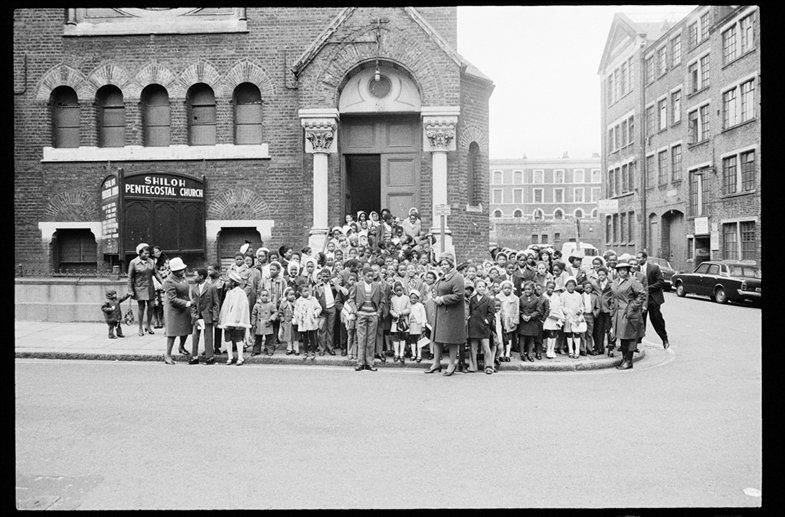
Shiloh Pentecostal Church

Staying on a Dalston vibe…. fresh from Autograph ABP comes Dennis Morris’ ‘Growing Up Black’. Born in Jamaica but  growing up in Hackney Dennis was encouraged to pick up a camera by a patron of his local  church, Donald Paterson. It became an obsession.

While his mates were football crazy he spent all of his time taking photos. Aged just 11, his photo of a PLO (Palestinian Liberation Organisation) rally was published on the front page of the Daily Mirror. He was paid £16. However, Dennis’ big break came when he met Bob Marley after a sound check at The Speakeasy in Margaret Street. Bob took a shine to the camera toting 14-year-old and invited him to be official photographer for the rest of that groundbreaking, but short lived, UK tour with the Wailers. The next morning Dennis packed his PE bag and off he went. It was the start of an auspicious career.

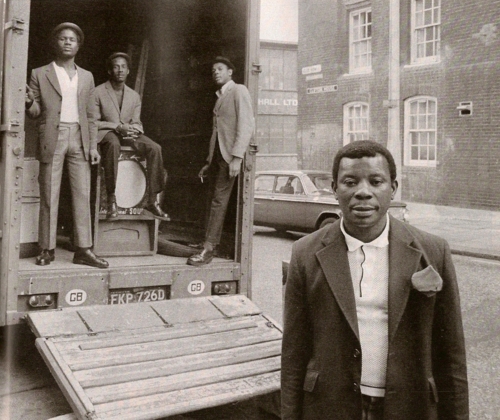
Admiral Ken & his Box Men

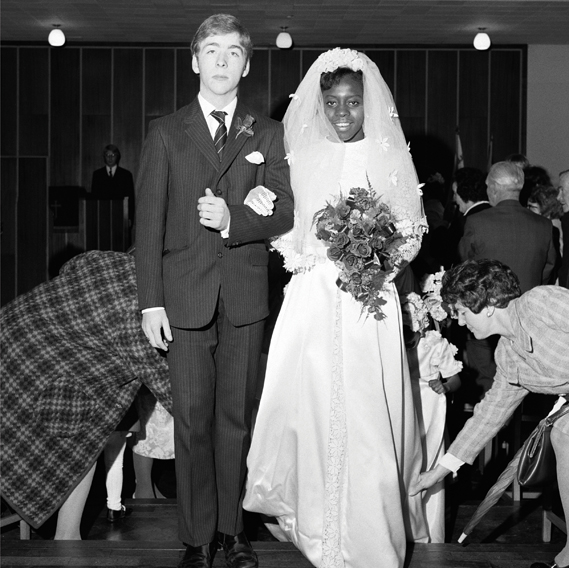
Despite not being able to scrutinise the whole of this book, due to the lack of readies required, I have gleaned that over the 95 B&W images it goes deep, very deep, into Dennis’ archive. What the viewer gets is the teenage Dennis Morris, hanging with his mates, shooting kids in the street, documenting mixed race weddings in Mare St Town Hall, focusing on Admiral Ken’s box boys and capturing some style and pattern at his home studio!

Dennis Morris-Home Studio: 1971-75

According to Stuart Hall, the founder of Birmingham’s seminal Institute for Cultural Studies, who wrote one of the pieces included in the book. “In this selection from his archive, Dennis Morris gives us a beautifully well-judged and eloquent portrait of the black diaspora, frozen at a particular moment in time. It is pregnant with anticipations of what is still to come, infused with future possibilities. We are invited to read these images backwards and forwards. Growing up black in the 1970s, they suggest, was not so much a state of being as a state of becoming.”

Wedding - Hackney Town Hall

Dennis Morris is a don and Growing Up Black, is indeed essential viewing. However, this book is lavishly produced and drops as a limited edition of 500 copies, each of which includes a signed silver gelatin print.  The package sells  for £300.00 – so, treat yourself or cajole your local library into ordering a copy.

Posted in Deep stuff, Urban runnings... | Tagged , , , , , , , , | Leave a comment

Earl Zinger’ s Kingsland Rag meets Operation Condor…

Just as I was imbibing the news that Hackney Council and the Met’s Operation Condor has homed in on Dalston and Shoreditch, targeting anyone flouting the licensing laws, clamping down on the illegal venues, using sniffer dogs outside the train stations  and busting taxi touts, beggars,  thieves and geezers with a taste for violence and affray…  up pops the ever dapper Rob G aka Earl Zinger with an apt and bluesy musical missive that pays homage to his gran… the Duchess Of Dalston … and takes us on a late night trawl of the Kingsland Road.

Posted in Urban runnings..., Words, Sound & Power | Tagged , , , , , , , , , | Leave a comment

Just thought I’d post this: Gwo’ka à Pointe à Pitre

While writing the David Hockney piece I had saxophonist David Murray quietly firing on all cylinders in the background. I suppose it was a conversation I’d had with Gerry Lyseight about the New York Loft Scene and Val Wilmer’s book As Serious As Your Life that prompted me to dig into the vinyl and pull out Murray’s debut LP ‘Low Class Conspiracy’. I bought that album in Ray’s on my way to work in Covent Garden. That was back in 1976, David Murray was 21 years old and as a “card-carrying Commie” I most definitely identified with the spirit of the album’s title.

Some years later, around time of his ‘Creole’ LP, I interviewed David for Straight No Chaser but before I could write it up it the cassette got lost in an office move! I was devastated. It was a deep interview that covered a whole heap of ground. As we talked, the sound of James Newton’s flute drifted magically from an adjacent window.

It was around the time of the Ken Burns jazz documentaries and he talked of his deep vexation of being written out of the music’s history by Wynton Marsalis’ who’s derisory view of the “free” players had been given disproportionate attention and credibility. We talked about Guadeloupe and Martinique and the writings of Aime Cesaire as opposed to those of Patrick Chamoiseau. He described playing his horn at a naming ceremony, alongside the ka drummers, in the midst of the cane fields, until his gums bled.

On tenor or bass clarinet, David Murray is of the most compelling and spiritually charged saxophonists alive today and following on from playing ‘Low Class Conspiracy’ it was a natural progression to touch down on his contributions to Kip Hanrahan’s Conjure collective and his expansive collaborations with the Gwa-Ko master drummers of Guadeloupe.

With David Murray’s Guadeloupe cane field  sessions in mind I just to had to share this firing slice of riddimic joy featuring François Ladrézeau. Flash it.

Posted in Deep stuff, Is That Jazz? | Leave a comment

The Paintings Of David Hockney: Still Smoking! From LA to The Yorkshire Dales

Saturday night… 9.30pm… Royal Academy in Picadilly… and it’s buzzing with people of all ages, nationalities and classes, all vibed at the prospect of viewing David Hockney’s A Bigger Picture.

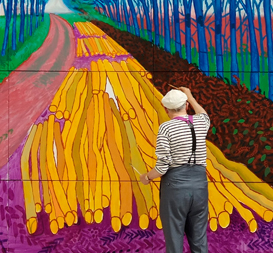
The Man at work

There’s been a rake of media publicity around Hockney’s work of late and it’s clearly reflected in the queues round the block at the Royal Academy and the tiny window for on-line tickets. Guaranteed to stoke the fires of controversy was an impish diss, aimed at Damien Hirst, whereby Hockney included the line, “All the works here were made by the artist himself, personally”, on the posters promoting his exhibition.

That said, he is undoubtedly an affable fellow and a serious grafter who is passionate about his craft.  As a painter has definitely endeared himself to both the media and public who are at one with his exuberant celebration of the Yorkshire countryside. Hockney is more hip than ever and not surprisingly his “slouchy… disheveled cool” has earned him style icon status.

Hockney was born in Yorkshire but is a long-time resident of LA.  Over the past couple of decades it’s his relationship with his photographer sister, Margaret, and his now deceased friend, Jonathan Silver, who initiated the 1853 Gallery in Saltaire,  that has consistently drawn him back to his birthplace.

1853 Gallery Saltaire

As one enters the octagonal space that opens this massive show, the viewer is confronted with the cycle of nature and the four seasons. While this show is full of life death seems to hang over it like a shadow. Set against the rich sienna coloured walls these large paintings set the scenario and immediately draw you in, making you instantly aware that it’s a combination of energy and abstraction that makes them work. Hockney’s  paintings make me smile and laugh. He challenges you to look hard and long, to penetrate the layers and go beyond the surface. If you said to Hockney that the Yorkshire dales or the English countryside have never looked like that, I’m sure he’d say, “But they do!”

This is a huge show and David Hockney, at 74,  is nothing less than prolific. It made me jealous and today, makes me think, why am I sitting here writing this when I could be creating something of my own. Maybe, I’m just reflecting on lessons learned. This exhibition gives us intimate access to the process involved in creating these works and Hockney wear his influences on his sleeve…. for example, think Vincent Van Gogh.

There’s a couple of rooms with earlier works including the Grand Canyon paintings and the photographic collages but we’ll skip over that and get down to the meat & potatoes and start  with an impressive couple of walls of small oil paintings and gouaches.

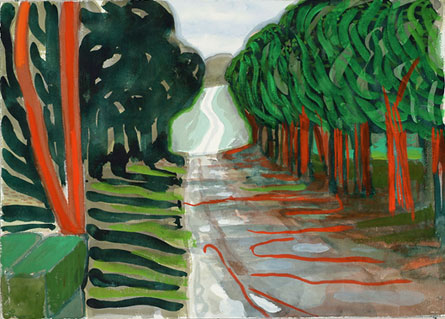
Arrival of Spring - Gouache

These “sketches” provide the foundation for a journey that progresses in a well defined order. Going from room to room is a thrill and at times the scale of it all is overwhelming. Some works were initiated in the field (literally) and finished in the studio. A painting like the Arrival Of Spring in Woldgate Wood borders on the “trippy” and definitely echoes his enthusiasm for creating theatre sets. Other works, like the cold, misty, November morning in Woldgate Wood, were dashed out over a couple of days! They are big paintings, done in panels. I’d loved to have been walking through that wood and come across Hockney, cap pulled down, overcoat on, fag hanging from his lip, hard at work…

'The Arrival of Spring in Woldgate, East Yorkshire in 2011 (twenty eleven)'.

November2006

Along with deciphering the techniques of the old masters Hockney has extended his romance with new technology by producing a room full of “paintings” done on his ipad. I had to agree with a perceptive fellow viewer that they lacked the resonance of the oils and it would have been interesting to see some of them back lit, as on the ipad.  Nit picking aside, the overall impact of his inkjet prints was impressive and the techniques employed thought provoking. How could you not be tempted to buy an ipad and treat it as a sketchbook after  seeing this show? In fact, you should, after seeing his real sketchbooks, have both! Hockey is an artist/craftsman equally at ease with the rigorous demands of the fine art tradition and the rapidly evolving digital age and I love that.

Maybe I was on overload by the time I encountered the room of paintings where he interprets Claude Lorrain’s 1656 painting, Sermon On The Mount. Sadly, despite Hockney’s enthusiasm for this painting, which he has “restored”,  his efforts simply washed over this viewer and as I stepped into the darkened room showing his split screen films I was ready to take the weight of my feet. Unfortunately, all the seats had been taken, curtailing one’s ability to relax and indulge in what has clearly become another dimension in the process.

I’d like to see this show again simply because the scale of it all doesn’t translate into a catalogue or a pack of postcards.  But if I can’t, then I’ll have channel the inspiration and energy I felt upon leaving the Royal Academy and get busy with the sketch book and replace those dried up tubes of paint. Now, there’s a thought!

For the word from the man himself check the video below or tune to BBC iplayer and check the interview with Andrew Marr.

.

Posted in Deep stuff | Tagged , , , , , , , , , , , | 8 Comments